
Why the Multi Academy Trust system will eventually fail
However, this will be catalysed by its own corruption and dysfunction, not by politicians.


As of January 2026, approximately 90% of secondary schools in England operate within Multi-Academy Trusts (MATs). This article explores why this model is detrimental to children’s educational experiences and contributes to the country’s evident national decline. It argues that the current MAT system should be dismantled, explains why such reform is unlikely to occur, and considers why the system is ultimately unsustainable and destined to fail.
What is a Multi‑Academy Trust?
This system was introduced by Tony Blair as part of his communitarian “third way” revolution of British society. Part of his key rhetoric during his rise to power was; Education, Education, Education, although he never disclosed his true intentions.
It was Blair himself who opened England’s first academy, The Business Academy Bexley, in 2002. The real driver of change though, occurred in 2006 when Blair got his controversial Education Bill through with the only resistance being a significant group of his own party.

The Bill enabled schools to sever from local authority oversight and to establish so-called “partnerships” independent of external bodies, forming “federations” that effectively consolidated multiple schools under shared governance. It also allowed businesses and voluntary organisations to establish foundation (trust) schools with substantial autonomy, including control over budgets and admissions. It was at this point, alongside contemporaneous NHS reforms, that I first encountered the term public–private partnership, which I have since come to regard as a warning sign of arrangements that primarily benefit entrenched interests rather than ordinary working people. The Bill received Conservative support and was pursued with enthusiasm by Michael Gove following his appointment as Secretary of State for Education in 2010.
At the time, many secondary schools were facing genuine structural and operational challenges. The traditional local authority system was often characterised by inefficiency, weak accountability, poorly maintained buildings and, in some cases, entrenched underperformance. The introduction of academies, with their more business-oriented ethos, initially helped to address several of these problems. There was a catch though, the much-needed money made available for schools was conditional on them becoming an Academy and partnering with other schools.
It was not long before economies of scale came to dominate, these institutions expanded into federations of five, ten, twenty or more schools, fundamentally altering their nature. These federations, now calling themselves Multi-Academy Trusts, have developed increasingly centralised and hierarchical governance structures, led by chief executives on extremely high salaries and supported by multiple layers of well-remunerated management, who rarely tread the school corridors.
A brief aside concerning Fabian Society member and initiator of the MAT system, Sir Anthony Charles Lynton Blair, born on 6 May 1953. He graduated from the University of Oxford in 1976 with a Second Class Honours BA in Jurisprudence and became Member of Parliament for Sedgefield in 1983. In 1993, Blair attended the Bilderberg meeting in Athens, often regarded as a rite of passage for prospective national leaders, signalling their alignment with a globalist agenda. He subsequently served as Prime Minister of the United Kingdom from 1997 to 2007.
In 1991, Blair wrote a telling article for Marxism Today, the in-house magazine of the British Communist Party and a prominent forum for Labour modernisers such as Blair. This contribution foreshadowed the party’s shift towards communitarianism, later branded as the “Third Way” or “New Labour”. These ideas were not original to Blair; rather, he was aligning himself with a broader global agenda of collectivism, pursued under initiatives such as Agenda 21 and framed in the language of sustainable development.
The more the word ‘citizen’ is used, the less satisfying it becomes – unless the idea of citizenship is allied to economic and social rights, as well as the rights as consumers of public and private services, and unless it implies obligations as well as rights. In other words, citizenship must be distinguished from individualism by insistence that a citizen is part of a wider community. - Tony Blair, Marxism Today 1991
In the article, Blair argues that we need to develop a modern understanding of society, asserting that traditional socialism is no longer fit for the realities of a post-industrial West. He emphasises that the political left must embrace modernity and articulate a new political language. He also endorses a central tenet of communitarianism: that rights should be accompanied by civic responsibilities.

Behind all the rhetoric, Blair recognised that gaining greater influence over the education system would help bring about long-term change and embed this new language and ways of thinking among the masses, advancing both his own and his masters’ global vision. After leaving office, Blair established the Tony Blair Institute for Global Change - the clue is in the name - which has since exerted significant influence on education policy internationally and is currently advocating a technocratic revolution in education. Technocracy, of course, being the contemporary driver of global change.
So, where’s the money going?
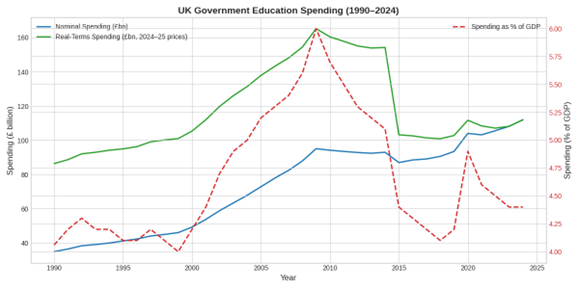
Spending on education has long been used as a political football; however, an examination of the data shows that national expenditure in this area has increased steadily over the long term, regardless of whether Conservatives or Labour have been in power. There was a relatively significant reduction in 2015, but spending has trended upwards again since then, although it has not yet returned to its 2008 peak. Government spending on education in 2025 stands at £135 billion, representing a real-terms increase of £15 billion compared with spending when Blair came to power in 1997.
This leads us to the next obvious questions: where is the money being spent, and is it being spent wisely for the benefit of students?
Let’s start by examining the trusts themselves. Below is the typical structure of a Multi-Academy Trust.
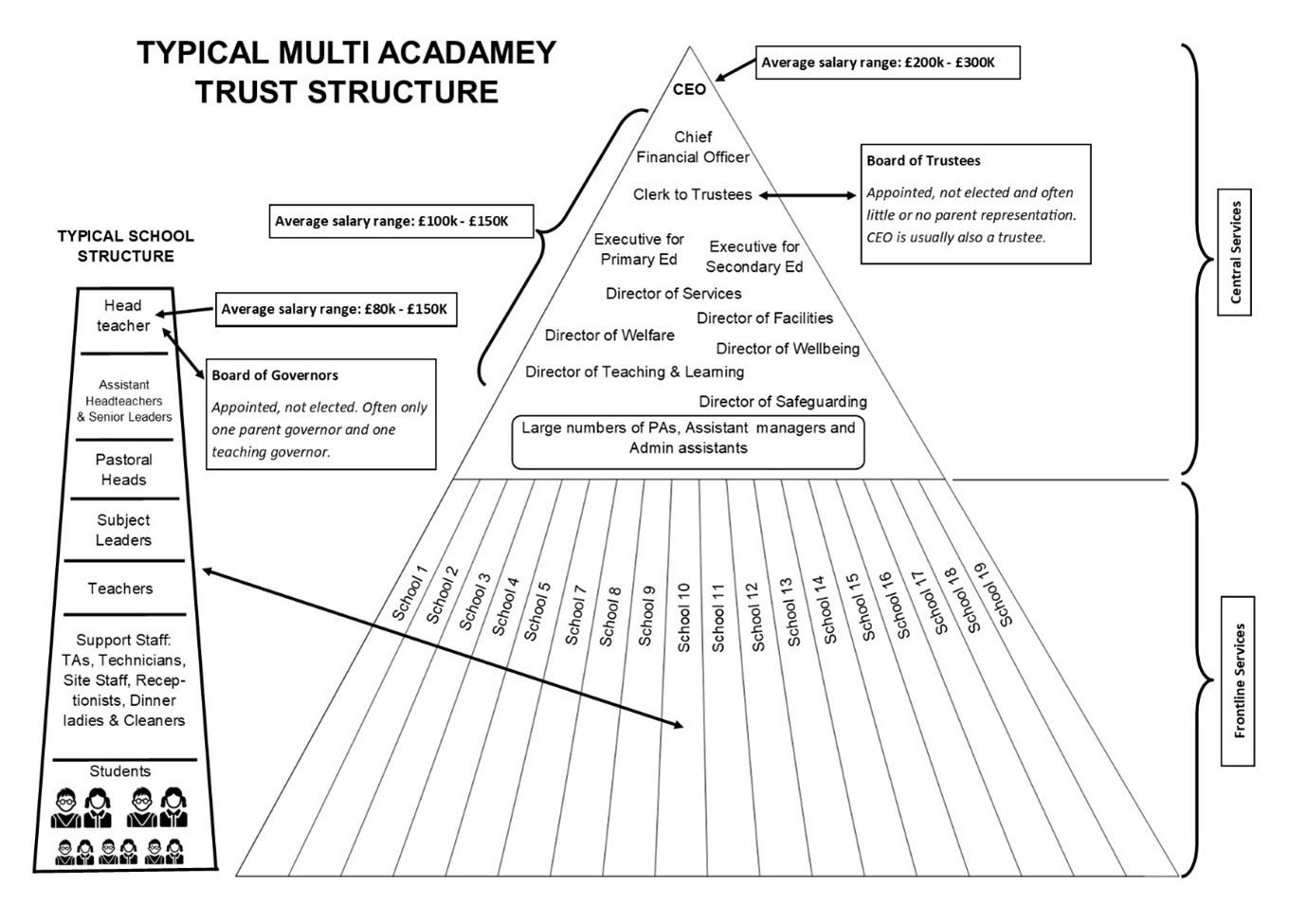
It is evident that, over time, the MAT system has evolved into a top-down, unaccountable bureaucratic blob, a gravy train for those who have climbed the greasy pole to the apex of the pyramid. More often than not, those occupying the upper echelons rarely set foot in a classroom and are frequently based in entirely separate buildings. I would argue that many of these roles are superfluous, and the executive salaries attached to them are excessive. Ironically, many who occupy these positions consider themselves socialists, yet they preside over the misdirection of vast amounts of taxpayers’ money that ought to reach the classroom but is instead absorbed by this mix of communitarian drones, useful idiots, and narcissists, whose mediocrity is enabling the decline of the system.
Entrenched Corruption and Financial Scandals
Public-Private Partnerships by nature breed corruption, and MATs are no exception. A simple Google search for ‘Multi Academy Trust financial scandal’ returns page after page of news stories documenting various misuses of funds within MATs. This provides yet further evidence that the system is unaccountable and suffers from a lack of scrutiny by the general public.
Here are six notable examples:
1. Wakefield City Academies Trust – Asset stripping and irregular payments
In 2017, one of the highest‑profile scandals in the multi‑academy trust sector centred on Mike Ramsay. Investigations found that he received unusually high levels of pay for short periods of work, including more than £82,000 for roughly fifteen weeks, with no evidence of proper contractual oversight. Further reports highlighted excessive expense claims and financial dealings with companies linked to him and his family. Former senior staff also described extravagant personal spending, including costly office refurbishments, at a time when schools within the trust were under severe financial strain. The trust ultimately collapsed, and its schools were re-brokered following sustained leadership and financial failings.
2. Bright Tribe Trust – Misuse of government grants and false claims
Bright Tribe Trust, which operated schools across England, became the focus of a 2018 BBC Panorama investigation alleging that it claimed substantial government funding for building and safety works that were either not completed or carried out to a poor standard. The trust reportedly claimed full grant amounts for projects that cost far less in practice and failed to deliver essential improvements. It also did not repay an unspent £1 million grant. Serious questions still remain about where much of the money ended up.
3. Durand Academy Trust – Executive pay scandal
Sir Greg Martin, long‑standing headteacher and later chair of governors at Durand Academy Trust in south London, came under scrutiny when it emerged that his total remuneration approached £400,000, far above typical headteacher salaries and even exceeding the pay of many MAT chief executives. Investigations revealed that Martin received: A substantial salary from the school, reported at around £229,000 plus additional income of around £160,000 from a leisure centre business operating on the school site, run through a company he helped establish.
This dual‑income arrangement raised serious concerns about conflicts of interest, related‑party transactions, and the adequacy of the trust’s governance. The trust later collapsed, and its schools had to be re-brokered into other MATs, all at the taxpayers expense.
4. The Priory Federation of Academies Trust – Embezzlement of public funds
In 2012, the Priory Federation of Academies Trust, in Lincolnshire, was the subject of a damning Department for Education investigation. The report uncovered financial mismanagement, misuse of public funds, conflicts of interest, and inappropriate behaviour by senior leaders, leading to the resignation of CEO Richard Gilliland and CFO Stephen Davies.
Key findings included:
· Senior executives using academy funds for personal expenses such as hospitality, travel, and other non‑educational purchases
· Unlawful severance payments made to departing staff without the required government approval
· Contracts awarded to companies with personal or professional links to senior leaders, bypassing proper procurement processes
· Instances of bullying, intimidation, and misuse of authority by senior staff
· Weak financial controls and ineffective governance, with trustees failing to challenge leadership or ensure compliance with financial and regulatory standards
5. Lilac Sky Schools Trust – Trevor Averre‑Beeson school ban
In 2017, Trevor Averre‑Beeson, founder and former chief executive of the now‑defunct Lilac Sky Schools Trust in Kent, was at the centre of one of the sector’s most serious individual controversies. Government documents and investigative reporting indicate that he authorised substantial payments, totalling several hundred thousand pounds, to companies he owned even after formally stepping down as CEO. He was also alleged to have secured a £1 million contract with the trust the day after leaving his post, without proper tendering or governing‑body approval. Subsequent government investigations identified more than £3 million of spending deemed “contentious, irregular or improper”, including connected‑party transactions and misuse of public funds. As a result, the Department for Education imposed a full ban on his involvement in the management of schools, but no criminal charges were made.
6. Shrewsbury Academies Trust – £3.7m Debt write‑off covered by taxpayers
In 2021, an investigation uncovered years of poor financial oversight at the Shrewsbury Academies Trust, culminating in its collapse and the Department for Education having to write off £3.7 million of debt. Concerns were highlighted by irregular spending by trust leaders, including £1,888 spent on alcohol and bar drinks, formally flagged as “contentious and potentially irregular.” Senior staff were also found to have stayed in hotels costing up to £270 per night, with one report noting that £832 had been spent on just three hotel rooms plus £451 spent on a Christmas meal for school leaders.
I will spare you, dear reader, any more of this nauseating detail, though the list could go on and on.
While researching for this article, I was genuinely surprised by how few voices are openly challenging what is, by any reasonable measure, a deeply corrupt system. I found a handful of Guardian articles that uncovered useful information, though they tended to default to blaming the Tories or calling for greater centralisation and a move further towards collective control.
Credit where it’s due: the National Education Union, somewhat late to the party, did finally acknowledge the scale of the problem with MATs in 2024 and commissioned some genuinely valuable research. Naturally, their proposed remedy is, once again, to move back towards collective Local Authority structures, but let’s focus on what their findings actually revealed.
Analysis by the Campaign for State Education (CASE) shows that the top 50 multi‑academy trusts spend an average of £68 million a year on executive salaries. This is seven times the amount spent on equivalent roles within local authority‑maintained systems. The research also found that MATs typically retain upwards of 7% of a school’s budget to fund their central services, with many of the larger trusts withholding between 14% and, in some cases, as much as 25%. These are extraordinary figures, representing a substantial transfer of taxpayers’ money away from frontline education to the captured education gravy train.
Take Delta Academies Trust, one of England’s largest MATs, as an example. Its annual income is not presented as a single transparent figure, though independent business data places it at roughly £102 million a year. The CEO is paid £315,000 annually. And as with most trusts, its published financial reports are opaque, making it difficult to determine the precise level of central service spending, though a conservative estimate would be £15 million.
Do you think the public is getting value for money?
The Myth that MATs have Raised Standards
The NEU has also challenged the government’s long‑standing claim that MATs have raised academic standards. A 2018 report by researchers at the UCL Institute of Education found no positive impact on the attainment or progress scores of pupils in MATs when compared with equivalent non‑MAT schools.
A separate EPI report (2017) concluded that “academies do not provide an automatic solution to school improvement” and highlighted “significant variation in performance across different types of academies and multi‑academy trusts”. It also found “no real change to the primary school test scores of incoming pupils once the schools become converter academies”.
Within a MAT, your child is also more likely to be taught by an unqualified teacher. A 2019 study published in the British Journal of Sociology of Education confirmed that academies are more likely than other types of school to employ teachers without qualified teacher status (QTS), a predictable cost‑saving measure aimed at the base of the pyramid.
NEU analysis of Ofsted ratings found that schools joining MATs are actually less likely to improve their Ofsted grade and, in many cases, more likely to see a decline at their next inspection.
Any critical thinking teacher already knows this. The near‑annual rise in GCSE and A‑level results is largely engineered through adjustments to grade boundaries and quota allocations to form a distraction for the public. This happens simultaneously as average reading ages, vocabulary breadth, numeracy skills, and attention spans all continue to fall, alongside a marked increase in poor behaviour, particularly forms characterised by ferrile rudeness. One must learn, there is always cover stories to direct away from the real aims of the system.
Lack of democratic process and accountability is another major concern surrounding MATs. While they do have trustees, who appoints them, and how well do they understand what is happening at the chalkface? Parental involvement is minimal to non‑existent. School governing boards are deliberately low‑profile, and it is rare to find more than one parent represented. The public must shoulder some responsibility here: widespread apathy and a willingness to surrender opportunities for influence reflect the broader demoralisation characterised by this system.
The Hotel California Analogy
At present, it is virtually impossible for a school to leave a MAT, even if it wishes to do so. A school can only exit a MAT through a formal process led and approved by the Department for Education (DfE). This is not a decision a school can make independently; it requires government approval and typically occurs only where there is a significant educational or governance concern.
No school has ever left a MAT and become a free school, as this is not permitted under English education law. Once a school becomes an academy, whether standalone or part of a MAT, it is bound by a funding agreement with the Secretary of State. There is no legal route for an academy to revert to local authority control in the way it originally converted.
The only circumstance in which a school can leave a MAT is through re‑brokerage, where the DfE transfers it to another MAT. “You can check out any time you like, but you can never leave.”
The Solution
As the subtitle of this article suggests, no meaningful solutions will come from politicians, in fact, they are part of the problem. I believe the MAT system will eventually collapse under the weight of its own corruption and dysfunction. I’m convinced of that. However, it will stagger on for another ten, fifteen, perhaps even twenty years. Sadly, it will need to reach a point of complete untenability before most people recognise what has happened.
That is of little comfort if you are a parent right now, so here are some practical solutions:
· The solution starts with you. Developing your own understanding of what education really is. Knowing what drives the system and how it expects you to react, can bring a solution.
· The solution is to reduce the consequences of impositions on your immediate environment. This can be done by home schooling. This can also be done by engaging with the system on your terms, taking what is useful to you, and ignoring the rest.
· The solution is not to let the system waste your time. If your child is rude and disruptive at school, that plays into the real goals of the system and they will be energy harvested. Don’t make excuses for them, get them to channel their suspicions of the system in the right way by learning how it works.
· The solution is to take personal responsibility to teach your children to think for themselves.
· The solution lies in unaffiliated solidarity, but not through being drawn into “their” groups or mass movements, which are always infiltrated and controlled. Instead, form small groups of three to five parents and challenge MATs, headteachers and governing boards on specific issues. Ask direct questions about spending, curriculum content and behaviour management. Insist on answers and establish who made the decisions - whether through meetings or Freedom of Information requests. Hold them to account and share those findings with the local community. You drive the change, not them.
Apathetic acceptance is not a solution!
For more context behind these suggestions and for a deeper look at the real aims of education rather than the official narrative, please read my other articles: The Stupidification Continues and Hey! Teachers! Leave Them Kids Alone!
Thank you for reading.
Acknowledgements & References:
Thanks to Mark Windows, the greatest teacher I never had. Inspiration for this article came from his shows: The Protocols of Power series and The Solution
BBC News. Blair wins crunch education vote
Blair, T. Forging a new agenda. Marxism Today. The Unz Review.
Education Policy Institute. The impact of academies on educational outcomes.
National Education Union. The government’s flawed case for a fully trust-led system.
National Education Union. The NEU case against academisation.
Priory Federation of Academies Trust. Investigation report. GOV.UK.
Taylor & Francis. Academies widen pupil inequality and “degrade” teaching workforce. Taylor & Francis Newsroom.
University College London. “Chaotic” government reforms are failing to tackle education inequality. UCL News.
Graph data sources:
Government expenditure on education, total (% of GDP) - United Kingdom | Data
United Kingdom - Government Education expenditure 1990 | countryeconomy.com