
The Stupidification Continues….
It’s deliberate and patently obvious!

The current Labour government has recently announced new National Curriculum recommendations for England, set to be implemented by September 2028. As I forecasted in my previous articles, education will increasingly globalise, persist in its reliance on ineffective inclusion policies, introduce more technocratic surveillance of students, and, in my view, further contribute to the dumbing down of the population.
So, why is the direction of travel so predictable? Well, it’s easy if you’ve done your homework. Here is a brief potted history of how we have got to this point:
Authoritarian intellectuals, since time immemorial, have sought to use education as a mechanism of control. Nothing has changed in that respect, only the technology, which now allows such control to be centralised on a global scale. They’ve told us as much, many times, in their own words, yet 99.9% of people fail to notice. And that, of course, is precisely the point of ‘their’ education system.
In 1807 elite German nationalist and authoritarian Johann Gottlieb Fichte said; ‘Education should aim at destroying free will, so that, after pupils have left school, they shall be incapable, throughout the rest of their lives, of thinking or acting otherwise than as their schoolmasters would have wished.’
In 1918 influential Harvard academic Alexander Inglis in his book ‘Principles of secondary education’ said:
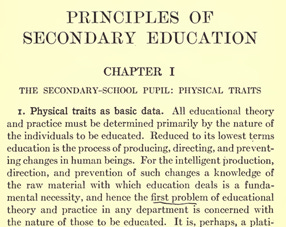
“All educational theory and practice must be determined primarily by the nature of the individuals to be educated. Reduced to its lowest terms education is the process of producing, directing, and preventing changes in human beings.”
The Education Act of 1944 (Butler Act), was a pivotal moment in the UK, introducing free secondary education and establishing the framework for modern schooling. It set up the tripartite system, dividing students into grammar schools, secondary modern schools, and technical schools.
This system was by no means perfect but there were loopholes in this system for bright students to navigate. It was also filled with maverick teachers and headteachers doing their own thing, and largely maintained a focus on academic excellence.
1946 was the birth of UNESCO. This largely undiscussed, and certainly never voted for, body of the United Nations (UN) has since been the main influence on curricula around the world.
Globalist insider Julian Huxley, the first Director-General of UNESCO, outlined the organisation’s guiding principles and vision in his 1946 work UNESCO: Its Purpose and Its Philosophy. In it, Huxley set out the goal of developing a “world culture” that would transcend national boundaries and foster a sense of shared purpose among all people.
He believed that genuine international cooperation required global planning and governance, and he envisioned UNESCO as a cornerstone of a future “world government”, coordinating collective efforts to manage global challenges.
Huxley was also a strong advocate of what he called “Scientific Humanism”, and saw eugenics and psychology as tools for applying evolutionary principles to human society, with the aim of globally centralised societal governance. And as with most globalist agendas the time scale for change is decades and centuries, not 4-year democratic cycles.
A British establishment interfacer, Bertrand Russell in his 1951 book ‘The Impact of Science on Society’ said: “The scientific rulers will provide one kind of education for ordinary men and women, and another for those who are to become holders of scientific power. Ordinary men and women will be expected to be docile, industrious, punctual, thoughtless, and contented.” Is this evident now by the enormous gap which has opened up between what is now called ‘the advantaged’ and ‘the disadvantaged’. Horrifying as that book is, Russell was correct in identifying that policy would be decided by experts. Of course, these experts are decided by them and the most recent curriculum update is, of course ‘evidence led’.
Benjamin Bloom, author of Bloom’s Taxonomy in 1956 said; “The purpose of education is to change the thoughts, feelings, and actions of students……….The ultimate aim of education is the development of the whole child - cognitively, affectively, and psychomotorically.”
With psychomotorically being the key word, Bloom’s framework has been widely used in western education curriculums to shift from sole focus on knowledge and skills, to a more psychological manipulative approach.
The measurable influence of UNESCO began to take hold in the UK during the 1960s and 1970s, coinciding with the gradual phasing out of grammar schools as the country shifted towards a comprehensive education system. This transformation was largely completed by the Education Act of 1976, which established comprehensive education as the norm.
At the same time, teacher training programmes began incorporating B.F. Skinner’s behaviourist methods. These were drawn from his book; The Technology of Teaching, which advocated for a rewards-based approach to learning, similar to the conditioning of Pavlov’s dogs. This inspired British psychologists to adopt and apply Skinner’s principles within UK schools.
“The use of Skinnerian behavior modification in the classroom is not about improving learning. It is about training children to respond in predetermined ways to certain stimuli - a process more akin to animal training than to education.” said Charlotte Thomson Iserbyt - Whistleblower from inside the US government who in her book The Deliberate Dumbing Down of America: A Chronological Paper Trail exposed documented evidence of a systematic, intentional effort by government officials, corporate interests, and global organisations to undermine intellectual development and transform education into a tool for social control. Iserbyt concluded; “The purpose of education reform is not to raise standards or to improve academic achievement. It is to transform education so that it produces obedient, compliant, non-thinking citizens who will accept social and economic control.”
In 1991, award-winning New York teacher John Taylor Gatto resigned from his position, disillusioned with the direction in which the US education system was heading. He said in his book “Dumbing Us Down – The Hidden Curriculum of Compulsory Schooling;
“David learns to read at age four; Rachel, at age nine: In normal development, when both are 13, you can’t tell which one learned first — the five-year spread means nothing at all. For a paycheck, I adjust David to depend on me to tell him when to go and stop. He won’t outgrow that dependency. I identify Rachel as discount merchandise, “special education.” After a few months she’ll be locked into her place forever.”
“Whatever an education is, it should make you a unique individual, not a conformist; it should furnish you with an original spirit with which to tackle the big challenges; it should allow you to find values which will be your roadmap through life; it should make you spiritually rich, a person who loves whatever you are doing, wherever you are, whomever you are with; it should teach you what is important, how to live and how to die.”
Getting closer to present day – Education for Sustainable Development (ESD)
In 1991, Robert Muller, Assistant-Secretary-General of the United Nations, released Essays on Education: A Vision for Educators, in which he proposed a “World Core Curriculum“ (WCC) designed to promote global and planetary consciousness in education. The following year, in 1992, John Major signed the UN’s Agenda 21, committing the UK to its goals. This decision was not part of the Conservative Party’s manifesto, it was not debated in Parliament, and it received minimal media coverage. In my view, this act of treason effectively surrendered the UK’s sovereignty and imposed the UN’s unstructured communitarian governance model on the British public without their knowledge or consent.
Shortly after, as part of the education goals of Agenda 21, came directives from UNESCO, specifically the section on Education and Participation, which aimed to enhance education and civic engagement in the name of “sustainable development” while recognising the role of various societal groups in its implementation. They said:
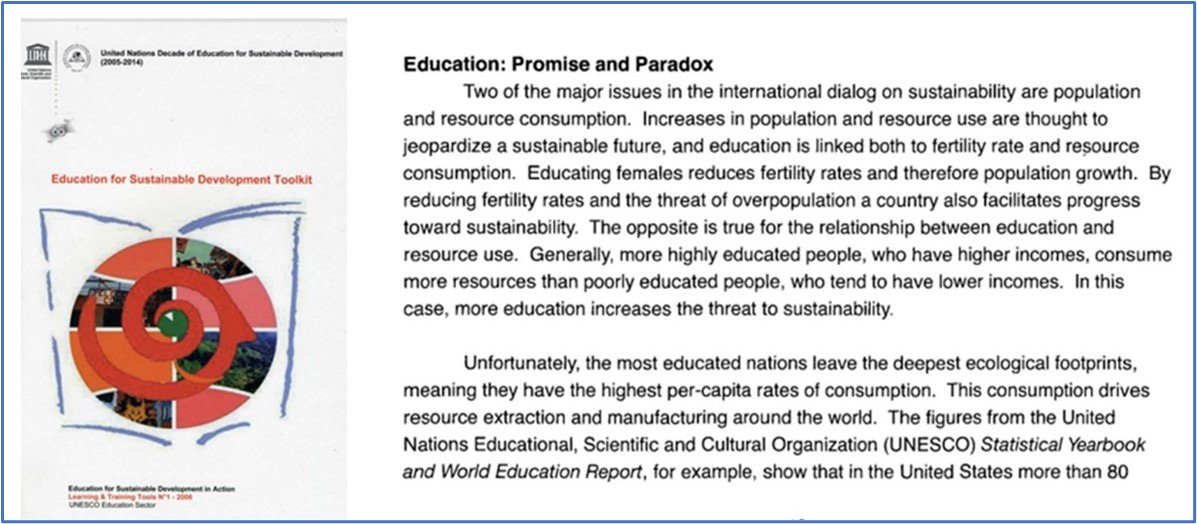
“Increases in population and resource use are thought to jeopardize a sustainable future, and education is linked both to fertility rate and resource consumption. Educating females reduces fertility rates and therefore population growth. By reducing fertility rates and the threat of overpopulation a country also facilitates progress toward sustainability. The opposite is true for the relationship between education and resource use. Generally, more highly educated people, who have higher incomes, consume more resources than poorly educated people, who tend to have lower incomes. In this case, more education increases the threat to sustainability.” – UNESCO: Education for Sustainable Development Toolkit.
Allow me to translate from UN global-speak: We aim to educate the entire global population to a uniform standard, ensuring they possess just enough knowledge to limit family size (depopulation agenda) and acquire the necessary skills for the roles the governance system demands. However, they must not be educated too much, otherwise they will consume too many resources and begin to realise the extent to which they are being controlled and exploited. Cloaked in the rhetoric of sustainable development, the goal is to raise living standards in the developing world while simultaneously lowering them in the developed world.
Lateral thinker and comedian George Carlin was able to join the dots because in 1996 he famously said:
1997 saw the election of globalist front man Tony Blair. “Education, education, education” was one of Blair’s key slogans when he rose to power and he wasted no time implementing UNESCOs agenda. Under the cover of injecting much-needed funding to improve school buildings in the 90s and 2000s, Blair introduced the Multi-Academy Trust (MAT) system to schools across England and Wales making large amounts of money available to schools, on the proviso that they made ‘partnerships’ collectivised and formed MATs.
The MAT system is template communitarian governance, top down, driven through NGOs and ‘approved’ experts reaching a pre-defined consensus. It rewards loyalty to the globalist communitarian view of the world. It creates management-heavy gravy trains for the key agendas to ensure they are disseminated even if failing. Centralised bureaucratic rigidity creates a conformist academic culture, where students are trained to memorise and reproduce facts, not to analyse or innovate.
In 2013, Social Impact Bonds (SIBs) were introduced, focusing on children’s futures by aiming to improve outcomes through funding early intervention services via results-based contracts. These bonds allow government bodies, investors, and service providers to collaborate on specific goals. They leverage social investment to fund services such as preventing children from entering care, supporting those at risk of school exclusion, or enhancing early childhood development, with government payments linked to the successful achievement of pre-defined metrics. This model shifts financial risk from service providers to investors, enabling greater upfront investment and potentially increasing private sector interventions.
Essentially, if investors can prove they’ve reduced the likelihood of a child being excluded from school, they can claim a return from the government, i.e. you the taxpayer. What could possibly go wrong? How would you feel about your child being “bet on”? It’s crucial to never consent to your child participating in any Social Emotional Learning programme.
Accelerator of Change
In 2015, the faltering Agenda 21 education objectives evolved into Agenda 2030’s Sustainable Development SDG 4 – Quality Education - though its underlying objectives remained largely unchanged. David Cameron re-affirmed the UK government’s full commitment to achieve all the SDGs by 2030. Were you consulted? Were you given an opportunity to vote on this? Was it included in any party manifesto? The answer to all of these is no. The government even maintains a tracker to monitor its implementation: Goal 4 - Quality Education - U.K. Indicators For The Sustainable Development Goals
In 2019, UN Secretary-General António Guterres stated:
“Today, education is at the heart of the Sustainable Development Goals. We need education to reduce inequalities, achieve gender equality, protect our planet, fight hate speech, and cultivate global citizenship.”
It is important to clarify the real meaning behind these nice sounding words – sustainable development and global citizenship.
Sustainable development can be understood as a rhetorical framework that conceals a systematic transfer of assets, resources, and property away from a vastly reduced population and into the control of a small, self-appointed global elite.
Citizenship, within the UN’s communitarian framework, represents a shift from individual rights to so-called community rights, where rights are conditional upon fulfilling certain responsibilities. This marks an erosion of fundamental freedoms and a move towards permissions-based societies.
If you visit the website of almost any UK school and read its values and ethos section, you will likely find the term ‘global citizen’. This is not something demanded by parents, but rather another example of a top-down imposition through unstructured global governance.
SDG 4 has driven not only the expansion of Personal, Social, Health and Economic (PSHE) education in England and the spread of sexuality education worldwide, but also the corporatisation of education through public–private partnerships (PPPs).
Teacher and author John Adam Klyczek, in his book School World Order: The Technocratic Globalization of Corporatized Education, argues that modern education reforms - such as charter schools, educational technology, data harvesting, and social-emotional learning programmes - are not merely pedagogical innovations, but components of a broader technocratic and corporate agenda with significant implications for democracy, national sovereignty, and the very nature of schooling itself.
This trend is evident in the proliferation of educational partnerships and PPPs across the sector. The global EdTech market is currently valued at an estimated $163–$187 billion (2024), with forecasts suggesting it could reach approximately $348–$395 billion by 2030.
Linear vs Lateral Thinking
Linear thinking is a systematic, step-by-step approach to problem-solving that follows a logical, sequential progression, similar to a straight line. This structured pattern of thinking makes outcomes more predictable because it follows a defined path. Linear thinking focuses on immediate cause and effect, failing to account for complexity, and missing solutions by only addressing symptoms rather than root causes.
Lateral thinking is a creative problem-solving method that uses an indirect and unconventional approach to find not always obvious solutions. Instead of following traditional, step-by-step logic, it involves disrupting thought patterns, challenging assumptions, and making non-linear connections between ideas to generate new insights and possibilities.
To my knowledge, and I’ve looked extensively, there have not been any studies on the percentage breakdown of linear and lateral thinkers in the general population. However, cognitive psychology and assessments like the Cognitive Style Index and Herrmann Brain Dominance Instrument (HBDI), which categorise people into different thinking patterns estimate it is 70% linear and 30% lateral. In my personal opinion the difference is starker. After observing the public between 2020 and present I would suggest 95% linear and 5% lateral.
As time has passed, increasingly structured and centralised education systems have produced ever more linear thinkers within the population. This is deliberate, of course, because linear thinkers are far easier to manage and control. Even those few who progress to so-called elite educational institutions do so by following a strictly linear pathway: pass the 11+, attend a grammar school (or, if privileged, a private school), or perform well in SATs to secure a place in the top sets of a multi-academy trust school. Then, achieve strong GCSEs, excel at A levels, succeed at university, and finally obtain a professional role that helps to sustain the existing system of governance. Said system, by design, rewards compliance, repeating curated knowledge through linear thought processes.
Those who consider themselves part of the elite by virtue of reaching Oxford or Cambridge are, in fact, often among the most deeply indoctrinated linear thinkers. This is precisely why they are chosen by the system to occupy roles within the intelligence services, NGOs, and politics.
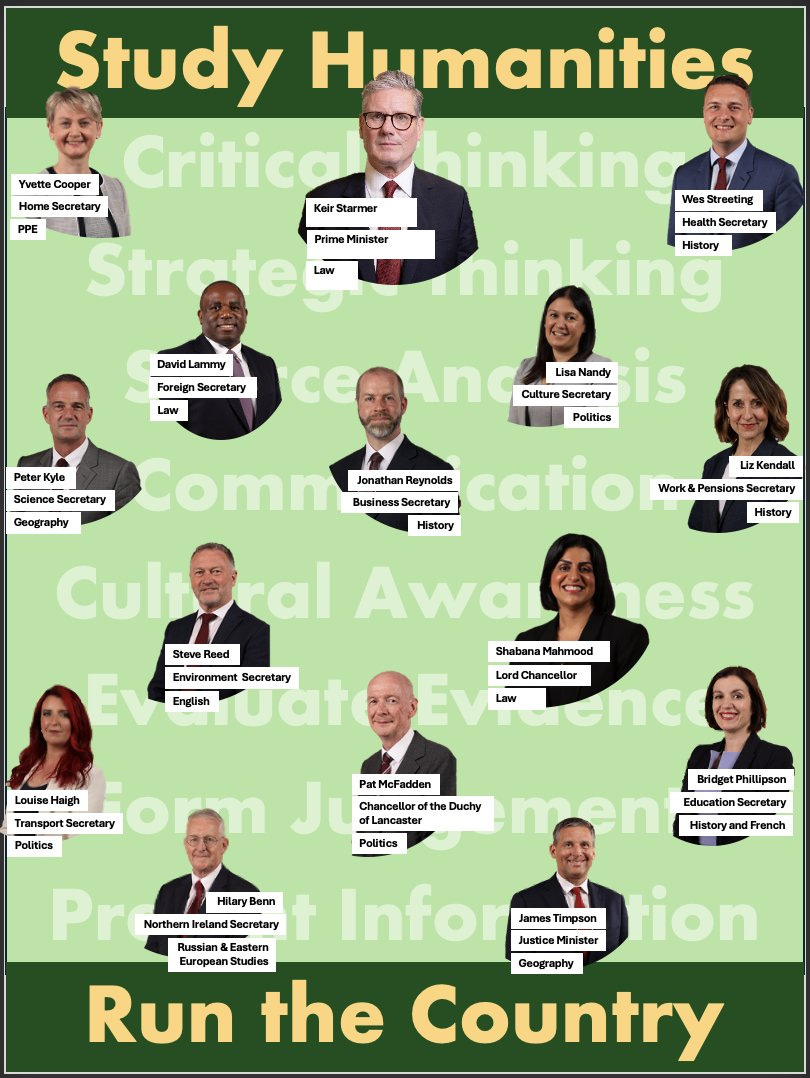
This poster is currently being displayed in English schools. You can make your own judgement on the thinking skills of these individuals?
Linear thinkers, even at senior levels, are often confined by the narrow corridor of accepted opinion, groupthink, and egregores, which leads them to never ask the critical question: who benefits within the broader context of global governance. As a result, they fail to connect the dots, allowing logical fallacies to guide their rigid thinking. This is the whole point of ‘unstructured’ communitarian governance, linear thinkers, the majority, fail to see the big picture and become a useful idiot for the system. Just try asking your local MP about Agenda 2030 and its connection to current policies, and analyse the response you get.
I’d like to make an important aside here: Lateral thinkers are often labelled as rebellious or disruptive within the school environment. While this may be true in certain cases, most lateral thinkers conduct themselves with politeness and respect; their perceived insubordination typically arises from a willingness to question prevailing ideas, systems, and norms. Ironically, it is often the linear thinkers who prove genuinely disruptive, as their predictable behaviours are used to justify the introduction of increasingly centralised surveillance and behaviour management systems.
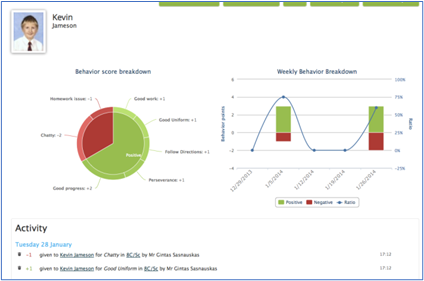
For example, consider the EdTech behaviour management portal ClassCharts, employed by numerous Multi-Academy Trusts (MATs), which operates as a school-based version of the Chinese social credit system. Such mechanisms arguably serve to condition students to accept a future society characterised by pervasive surveillance.
Lateral thinkers approach situations from multiple perspectives, quickly identify logical fallacies, and are unafraid to look beyond the limits of the Overton Window in search of answers. Linear thinkers, on the other hand, have been conditioned to label lateral thinkers as ‘conspiracy theorists’ or ‘far right’, dismissing these ideas with contempt, and to remain on their predetermined path. Believing they have joined the elite, they have not. They are merely better-paid, compliant useful idiot managers of the system.
Fundamentally, the system incentivises and advances linear thinkers, as they are more easily controlled. The true architects of the system are fully aware of this dynamic and have intentionally structured it in such a manner.
These so-called architects of the global system, for the sake of appearances, enroll their own children in the most prestigious private schools and elite universities. Yet it is not within these institutions that their genuine education occurs. Their true learning takes place within the family, where they are taught to think in broader, more strategic terms, and to operate across longer timelines. With instilled arrogance and audacity, they are entrusted with accumulated knowledge preserved through generations, often transmitted through exclusive networks or secret societies.
By contrast, the education system designed for the working and middle classes serves a markedly different purpose: to maintain social hierarchy and produce compliant, conforming citizens. Since the implementation of UNESCO’s educational policies, several trends have become apparent across Western nations, the most detrimental of which is the policy of inclusion.
The shortcomings of this approach are seldom acknowledged by those responsible for its enactment. Instead, policymakers and administrators persist in reinforcing failed strategies, as open criticism falls outside the narrow corridor of acceptable opinion. Moreover, to contest such initiatives would be to risk losing the built-in system gravy-train that invariably accompanies these agendas.
The Inclusion Deception
Implementing inclusion policies has been the primary objective of UNESCO’s educational toolkits since 1992. However, this policy has, in the western world, lowered standards across the board, leading to a “race to the bottom.” Consider the following scenario: Take five students with special educational needs (SEN), along with three others who exhibit serious behavioural issues, all of whom prior to the mid-1990s, would have been placed on alternative curricula, but now they are in mainstream classrooms. Even a linear thinker can deduce that the average performance will drop, and standards will inevitably fall. Any teacher who has been attentive to these changes will recognise this trend and lament the challenge of planning lessons for such a wide-ranging abilities and needs. When you scale this up to an estimated 8 million lessons per day in the UK (even when factoring in setting and streaming), over the course of 30 years, the resulting trends are hardly surprising.
Average reading ages falling - Evidence: What next for children’s reading? - CfEY
Average vocabulary counts lower - Evidence: The Word Gap – Oxford University Press & The dawn of the post-literate society
Number of students not achieving functional maths levels rising - Evidence: 17 million adults in England have a low level of numeracy, equivalent to a primary school standard -
Attentions spans declining - Evidence: How Has Covid Impacted Children’s Learning?
Increased levels of disruptive behaviour - Evidence: Alarming rise in challenging parent and pupil behaviour - Education Support
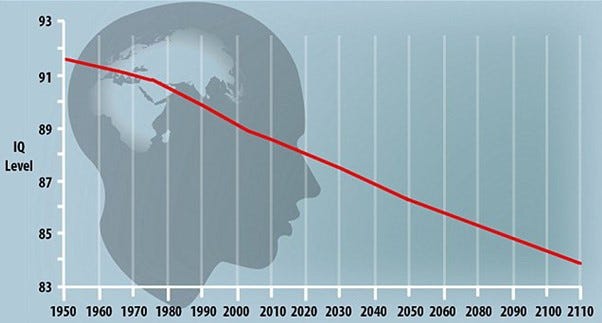
Average IQs declining since 1970s - Evidence: Flynn effect and its reversal are both environmentally caused by changes in education, nutrition, family size, reading habits, and exposure to technology.
All of this is taking place alongside the near-annual increases reported in GCSE and A-level results. Do you smell a rat? I do. Yet, if one is a rigid, linear thinker, the instinct is to blame mobile phones. While they are undoubtedly a factor and the obvious ‘dot’ to connect, there is a far more insidious dynamic at play, apparent to those capable of thinking laterally.
The New Curriculum Recommendations
With all the above in mind, let’s take a look at the new curriculum recommendations and approach them with a bit of lateral thinking. So, where has this new curriculum actually come from? Well, it certainly hasn’t emerged from the mind of Education Secretary Bridget Phillipson (a Fabian Socialist), nor even from its author, Becky Francis (an Intersectional Feminist). Its origins lie in top-down, unstructured governance stemming from Agenda 2030’s Sustainable Development Goal 4, channelled through UNESCO directives.
The ‘unstructured’ element allows for minor variations at the national level, creating the illusion of sovereign decision-making. The UN refers to this as ‘Glocal’ – global to local. For those of us who have spent many hours wading through UN and government documents, it becomes clear that they are always front loaded with seemingly reasonable objectives, in this case, improving literacy and oracy. Filled with pleasant-sounding jargon and buzzwords, this kind of language acts as doublespeak, concealing the real intentions behind the stated goals.
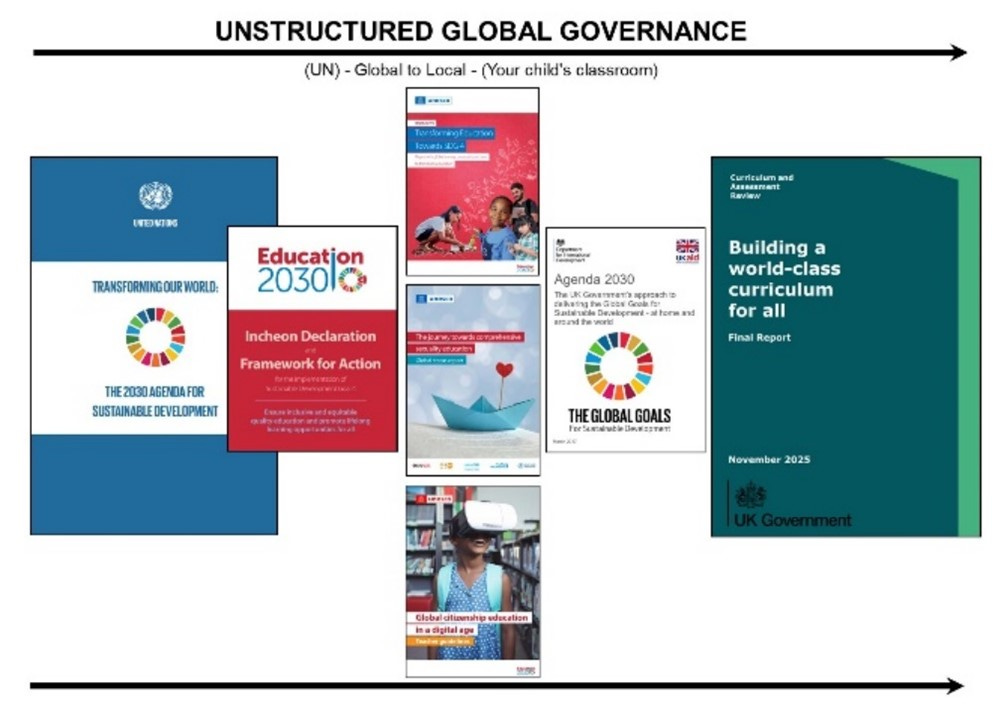
The report in full can be viewed here.
Most of the surface-level recommendations amount to little more than tinkering at the edges of the existing system, things like reducing exams by 10%, introducing diagnostic tests in English and Maths for Year 8, scrapping the Baccalaureate, and allowing all pupils to take Triple Science. These represent the local concessions which are irrelevant to the main goals. It’s also worth bearing in mind that the UK curriculum is already closely aligned with the priorities of the UN, so there is relatively little left to alter.
The 4 core drivers of remaining change come in the following recommendations:
1. More focus on social diversity - Stronger representation should be made of “the diversity that makes up our modern society, allowing more children to see themselves in the curriculum.“ Evidence-led guidance on curriculum and pedagogical adaptation.
Full alignment with Agenda 2030 SDG 4.5: “By 2030, eliminate gender disparities in education and ensure equal access to all levels of education and vocational training for the vulnerable, including persons with disabilities, indigenous peoples and children in vulnerable situations.”
Full alignment with Agenda 2030 SDG 4.7: “By 2030 ensure that all learners acquire the knowledge and skills needed to promote sustainable development, including … human rights, gender equality, promotion of a culture of peace and non-violence, global citizenship and appreciation of cultural diversity and of culture’s contribution to sustainable development.”
Full alignment with UNESCO’s curriculum framework: “Guide for ensuring inclusion and equity in education” emphasises that “education systems and programmes” must recognise learners’ diversities as opportunities, and ensure inclusive and equitable learning for all.
Full alignment with UNESCO’s curriculum framework: “Mainstreaming SDG4-Education 2030” guidelines highlight curriculum, teacher training, materials and pedagogy as essential to ensuring that the diversity of learners (culture, language, disability, gender etc) is accommodated.
So, what will this actually look like in schools? The so-called evidence-led guidance will result in yet more inclusion policies and further instances of reverse discrimination in favour of selected minority groups. Overall standards are likely to fall even further, continuing the ongoing decline. In the name of promoting cultural diversity, this approach will ultimately dilute native culture and, paradoxically, generate greater tensions within schools.
2. Statutory citizenship classes - The government should introduce a statutory measure to ensure that all children are taught citizenship classes at primary school, which should include elements of financial and media literacy, and climate change and sustainability.
Full alignment with Agenda 2030 SDG 4.7: “education for sustainable development and global citizenship”. This explicitly calls for pedagogy and curriculum that develop knowledge and skills for sustainable development, human rights, gender equality, global citizenship, cultural diversity.
Full alignment with UNESCO’s curriculum framework: guidance emphasises that curricula should embed “global citizenship education (GCED)” and “education for sustainable development (ESD)” as part of implementing SDG 4.
Obviously, the citizenship agenda is being pushed heavily here. Let’s remind ourselves of their interpretation of citizenship, as previously discussed in this essay; namely, the embedding of a transition towards a technocratic, permissions-based society. Do you see the big picture yet?
It is also stipulated that, through the teaching of citizenship, students will be shown how to recognise misinformation. One can’t help but wonder whether they’ll be drawing on the numerous indiscretions provided by the BBC.
3. Slim down GCSE content - Individual GCSE subject content should be slimmed down, particularly in history and sciences, to give pupils more time for non-assessed but mandatory subjects such as PE, citizenship and relationships, sex and health education.
Full alignment with Agenda 2030 SDG 4: It emphasises “relevant and effective learning outcomes” and the need for curricula to be responsive and coherent with the demands of the 21st century. From the “Unpacking SDG4” guide: “Focus on effective and relevant learning may require review of existing curricula frameworks; teaching and learning contents, pedagogy, materials and classroom teaching practice; assessment frameworks…”
Alignment with UNESCO’s curriculum framework: “Education 2030 Framework for Action” states that the curriculum must be fit for purpose: it needs to keep pace with changing demands, ensure progression, and promote learning throughout life.
This is simply a reduction in the content of some subjects to make room for more time to be spent on PSHE and citizenship where aforementioned content can be further embedded into the system.
4. Develop the national curriculum as a digital product that can support teachers to navigate content easily.
There is actually little further detail on this recommendation, however it does somewhat align with the The UN’s Global Digital Compact, which wants to digitally triangulate through A.I. the data of governance systems and citizens - and I believe will be used to further centralise control of precisely what is taught in the classroom. This will further undermine teacher autonomy and, with the increasing integration of AI, may ultimately result in the displacement of many teaching jobs. It is also no surprise that the Tony Blair Institute for Global Change in July 2023, published a report calling for a “Digital Learner ID” for every pupil in England - described as “a digitalised record for every pupil” containing test results, attendance, weekly assessments, homework, and non-academic achievement.
To summarise my learnings thus far, I have come to believe that education is being utilised as a primary driver of change, facilitating the emergence of a new feudal technocratic era. The ultimate objective appears to be the construction of a system intended to hollow out the middle classes, who are perceived as consuming excessive resources, and to reduce the wider population to a smaller, more obedient, and compliant proletariat.
I also believe this system will eventually fail. When, I don’t know. But, if enough of us do our homework and every now and then lob a spanner in the machine, it will grind to a holt, and we can make it fail faster!
Solutions for Parents
Here are 2 options I would advise to parents:
1. Home Schooling
If it’s within your means to do so, this is the best option. Although increasing regulations are making the process more complicated, it remains entirely possible. There is now a huge array of resources available to assist parents home-schooling and my recommendation would be to supplement by involving your child in as many clubs and activities as possible, and to build connections with other home-educating parents in your area.
Due to personal circumstances this option is very challenging for many people!
Some reading this may believe that private education is a better option. Personally, I think not. Although privately educated children have some obvious advantages they will also have been subjected to the same indoctrinations as the state sector. And of course, the financial aspect excludes many of us anyway.
2. The Mixed Option
This approach adopts the most effective elements of the state education system, discards those deemed less beneficial, emphasises close parental oversight of the learning process, and substantially supplements formal schooling with home-based education.It’s the option I’ve chosen for my two boys. They still attend state schools, but we undertake a significant amount of homeschooling alongside this, both to unpick some of the misconceptions taught in subjects such as PSHE and Geography (for example, those relating to anthropogenic climate change) and to specialise their knowledge and skills in areas that genuinely interest them.
This way, they benefit from social interaction with their peers, competitive sports, and the academic foundations that the state system still offers. At the same time, they learn to recognise when to listen politely but critically ignore some of the content presented to them.
This approach does, however, require a great deal of parental oversight. Parents need to educate themselves about the system in which their children spend around eight hours each day. Much of our monitoring happens informally, often around the dinner table, and my boys understand that education neither begins nor ends at school.
While valuable knowledge can certainly be gained along the way, qualifications such as GCSEs and A Levels are, in many ways, simply hoops to jump through in order to navigate the current system. They are not necessarily true measures of excellence. My hope, as a parent and a teacher, is to help my sons develop the lateral thinking skills needed to become independent, thoughtful human beings.
Thank you for taking the time to read this. Of course, you are entitled to disagree with my arguments presented in The Stupidification Continues; I would simply encourage you to reflect critically on the evidence and observations that surround us.
References
UN & UK Government Documents:
United Kingdom, Department for Education. 2025. Curriculum and Assessment Review Final Report: Building a World-Class Curriculum for All.
United Kingdom, Department for International Development. 2018. Agenda 2030: Delivering the Global Goals.
United Nations. 2015. Transforming Our World: The 2030 Agenda for Sustainable Development.
United Nations Educational, Scientific and Cultural Organization (UNESCO). 2015. Education 2030: Incheon Declaration and Framework for Action towards inclusive and equitable quality education and lifelong learning for all.
United Nations Educational, Scientific and Cultural Organization (UNESCO). 2024. Global Citizenship Education in a Digital Age: Teacher Guidelines.
United Nations Educational, Scientific and Cultural Organization -Agenda 21- UNESCO. 2006. Education for Sustainable Development Toolkit
Books & Articles:
Bloom, Benjamin. 1956. Bloom’s Taxonomy.
Bratsberg & Rogeberg. 2018. Proceedings of the National Academy of Sciences - Flynn effect and its reversal are both environmentally caused.
Education Endowment Foundation. 2020. How has Covid impacted children’s learning?
Education Support. 2024. Alarming rise in challenging parent and pupil behaviour.
Gatto, John Tayler. 1991. Dumbing Us Down – The Hidden Curriculum of Compulsory Schooling.
Huxley, Julian. 1946. UNESCO: Its Purpose and Its Philosophy.
Inglis, Alexander. 1918. Principles of secondary education.
Klyczek, John Adam. 2029. School World Order: The Technocratic Globalization of Corporatized Education.
Marriott, J. 2025. SubStack: The dawn of the post-literate society.
Millard, Will. 2022. Centre for Education and Youth (CfEY). What next for children’s reading?
Muller, Robert. 1991. Essays on Education: A Vision for Educators.
National Literacy Trust. 2022. 17 million adults in England have a low level of numeracy, equivalent to a primary school standard.
Iserbyt, Charlotte Thomson. 1999. The Deliberate Dumbing Down of America: A Chronological Paper Trail.
Russell, Bertrand. 1951. The Impact of Science on Society.
Skinner, B.F. 1968. The Technology of Teaching.
Oxford Language Report. 2018. Oxford University Press. Why Closing the Word Gap Matters:
Tony Blair Institute for Global Change. 2023. The Future of Learning: Delivering Tech-Enabled Quality Education for Britain.
Podcasts:
Your Indoctrination and Education - Windows on the World
Under the CAR bonnet with Schools Week and Professor Becky Francis - YouTube
unesco is a horrid organisation, and at the centre of not just the 'education' drive, but also the focus on 'ethics' as contemporary control mechanism
incidentally, they published a range of documents in 1949 which you might 'like'
https://escapekey.substack.com/p/the-united-nations-and-world-citizenship?utm_source=publication-search
Thank you for that. I knew a lot of the back ground but not where we are now so much. Although if I'd had to guess I probably wouldn't have been to far away. If you assume nothing they do will actually benefit children you probably won't go far wrong .